Tree Removal in Akron, OH
Taking a tree down is a rigging job, not a saw job, and the quote should show which one you are buying.
A removal quote is built from four numbers: height, trunk diameter at chest height, how far the tree is from anything you cannot replace, and how much room a truck has to work. Two trees of the same size can differ by a factor of three on those numbers alone. This page explains what moves the price in Akron, what a written quote should contain, and where the city permit applies.
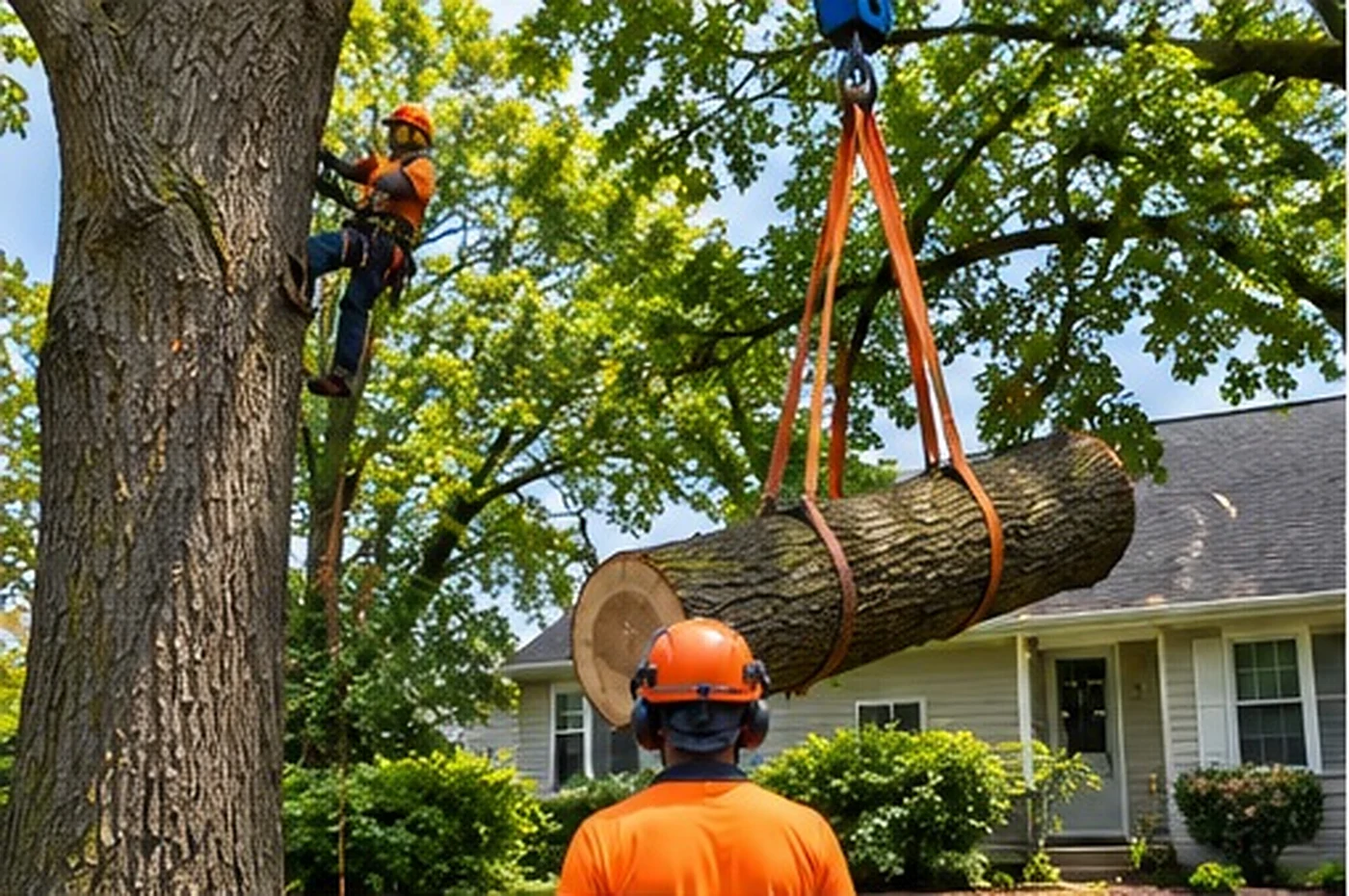
A crew walks up and reads the tree before it names a price. Height decides the equipment: a small tree under 30 ft can usually be felled in a controlled direction, while a 70 ft oak next to a house is worked down in sections and lowered on ropes. Trunk diameter decides how much wood has to be carried out and how long the saws run. Access decides whether a bucket truck can park on the driveway or whether every piece comes off on a rig.
Targets are the third input. A roof, a carport, a fence, a shed, a service drop or a neighbor's garage changes the method from felling to rigging, and rigging is slower. A crane removes the risk of working over a structure but adds a large fixed cost, so it usually only pays on the big removals.
National published ranges in 2026 run from $400 to $1,200 for a typical removal, with an average around $850. Height bands tell you more: under 30 ft $200 to $500, 30 to 60 ft $500 to $1,500, 60 to 80 ft $850 to $2,000, and over 80 ft $1,200 to $2,500 or more. The published floor is about $200 for a small accessible tree and the ceiling reaches $3,000 for a large or complex removal.
Those are national figures from HomeGuide, not Akron figures. Local quotes in Summit County land inside or above them depending on the property: a dense subdivision lot where the truck cannot leave the street sits at the top of a band, while a tree in an open backyard sits at the bottom.
Write the scope down before anyone starts a saw. A complete removal covers the tree, the brush, the hauling, and the cleanup of the work area. The stump is a separate line: a flush cut leaves the stump and the main roots in the ground, and grinding is quoted on its own at $100 to $500 or more per stump.
Akron city services (311) is solely and legally responsible for public trees along city streets, in parks and on city property, and a permit the crew pulls is required for work on a public tree. The tree on the tree lawn in front of the house usually belongs to the city, not to the deed. A crew that takes it down without the permit is creating a problem for the homeowner.
Inside the city limits the answer comes from Forestry. Outside Akron, suburbs and townships run their own street-tree rules, and some require a removal permit for a tree in the right of way. Ask the crew which authority applies and who files the paperwork before the date is set.
Published national ranges run $400 to $1,200 for a typical removal, with an average around $850, and bands by height: under 30 ft $200 to $500, 30 to 60 ft $500 to $1,500, 60 to 80 ft $850 to $2,000, and over 80 ft $1,200 to $2,500 or more. Local quotes move with access, targets under the tree, and how the wood leaves the property.
A permit is needed for a public tree: one along a city street, in a park or on city property. Akron handles those through 311, and the city Tree Commission hears resident complaints about them. A tree on private property does not need the city permit, but confirm where the right of way ends before you assume the tree is yours.
Usually yes. A crew either fells the tree into a clear drop zone or works it down in sections and lowers each piece on a rig. A crane is chosen when the piece weight or the target outweighs the rigging approach, and it adds a fixed cost to the job.
Ask explicitly. Many quotes remove the tree and the brush but leave the wood bucked on site and the stump flush cut. Hauling the wood away and grinding the stump are separate lines, and stump grinding is published at $100 to $500 or more per stump.